
Underfloor heating delivers even warmth, frees up wall space and pairs well with modern insulation. We look at where it works best and how to plan an installation.
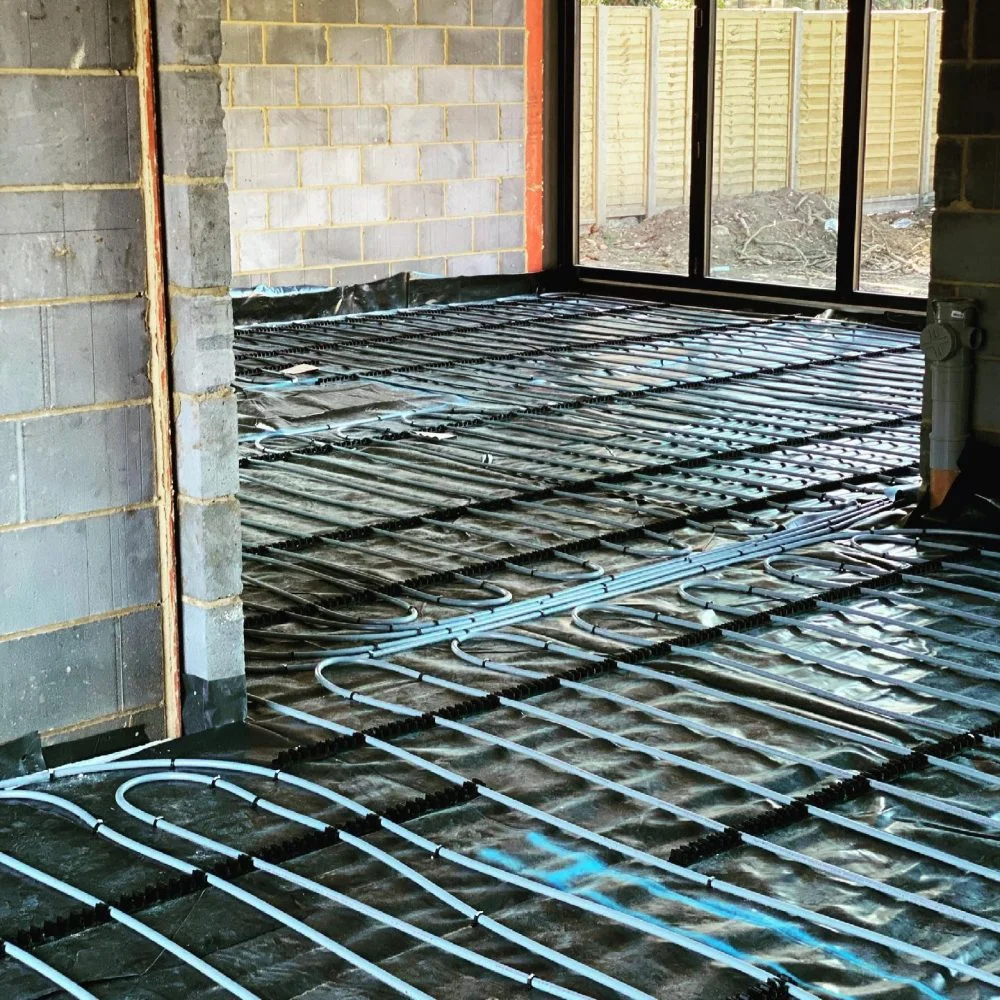
Underfloor heating turns your floor into a large, gentle heat emitter. Instead of concentrating warmth around a single radiator, it spreads across the room at a lower surface temperature. The result is an even, draft-free comfort that many homeowners prefer in kitchens, bathrooms, and open plan living areas where wall space is precious and furniture layout would otherwise fight with conventional radiators.
Because the heat rises uniformly, perceived comfort often feels higher at lower air temperatures compared with radiator led rooms. That can support efficiency, particularly when paired with modern insulation and boilers or heat pumps running at lower flow temperatures.
Water-based underfloor heating connects to your central heating boiler or heat pump through a manifold and loops of pipe buried in the floor structure. It is popular in new extensions, new-builds, and full renovations where floor build ups can be planned early. Running at lower flow temperatures than radiators, it works efficiently with condensing boilers and suits future heat pump upgrades in many properties.
Electric underfloor heating uses cables or mats and suits smaller areas or retrofit projects where raising floor levels for piped water is impractical. It can be responsive for bathrooms or single rooms, though running costs depend on tariff and usage patterns. An engineer should help you weigh electric against water-based options based on room size, use, and how the space connects to the rest of the home.
Open plan spaces benefit strongly because there are no radiators breaking up walls or blocking furniture. Hard floor finishes such as tile, stone, and engineered wood conduct and release heat well. Upstairs bedrooms can work with careful design, though response times are slower than radiators, which matters if you expect rapid temperature changes several times a day.
Properties across Surrey and Berkshire often combine extensions with existing radiator systems. Hybrid designs are common: underfloor heating downstairs in a new kitchen diner, radiators retained elsewhere. Zoning and controls must be planned so each part of the system operates at appropriate temperatures without forcing the boiler to run inefficiently.
Ideal for kitchens, bathrooms, and open living spaces
Suits hard floors and modern insulation levels
Works well with lower temperature heat sources
Requires early planning in renovations and new builds
Successful installation starts with heat loss calculations and a clear floor build specification. Pipe centres, insulation boards, and screed or overlay systems affect output and response. Cutting corners on insulation beneath pipes loops often leads to sluggish warm-up or heat loss into subfloors, particularly over unheated spaces.
Manifold location, flow rates, and mixing controls must be accessible for future servicing. Commissioning balances loops so each zone receives the right flow. When combined with heat pumps, the design must respect the lower delta T those units prefer. Experienced installers coordinate with builders and floor finishers so the final surface protects the installation without trapping access points.
Underfloor heating warms the floor mass, so it is slower to react than radiators. That suits spaces occupied for long periods but is less ideal if you expect rapid boost heating several times daily in one room. Programmes should reflect that inertia: start heating earlier rather than cranking the temperature late.
Running costs depend on fuel type, insulation, and how the system is zoned. Pairing water based underfloor heating with a modern boiler or heat pump at appropriate flow temperatures keeps running costs competitive. Electric mats in small wet rooms can be economical when used for short, timed periods rather than all day background heat.
Tile and stone conduct heat well and are popular over water systems. Timber requires careful specification to avoid excessive resistance or movement from temperature cycles. Carpets with high tog ratings reduce output and should be accounted for in design calculations. Furniture placement should leave margin around manifolds and avoid trapping heat under solid units where airflow is blocked.
Wet rooms and level access showers pair naturally with underfloor heating, reducing cold floor shock and helping drying. Discuss thresholds and waterproofing with your installer and tiler early so heating pipes do not compromise tanking details. Our plumbing team often coordinates bathroom work alongside heating installs. Good coordination between trades prevents costly rework after screed is down.
Acoustic considerations matter in flats and bedrooms above heated floors. Proper insulation and decoupling reduce footfall transfer. Your installer can advise on build up height versus performance so you do not lose ceiling height unnecessarily in lower ground rooms.
Shoosmith has installed underfloor heating in extensions, renovations, and new build projects across the South East. We design systems to match how you use each space, integrate sensibly with existing central heating, and leave you with controls you understand. Browse our case studies for examples, explore our underfloor heating service, or get in touch to discuss plans, timings, and how piped zones could fit your property.
Prefer to talk? Call us on 01932 429330. We’re available Monday to Friday, 9:00am–5:00pm.

We provide a full range of heating and plumbing services, from boiler servicing and repairs to complex systems like underfloor heating and plant rooms. If you've got something in mind, it's always worth giving us a call.
Yes, we handle everything from minor repairs to large, complex heating systems in bigger homes and developments.
We work across the South East, primarily Surrey and Berkshire, supporting homeowners and property developers with heating and plumbing projects. If you are outside these areas, feel free to get in touch and we will do our best to help.
Yes, we provide clear and transparent quotes so you understand exactly what’s involved before any work begins.
Yes, all labour is backed by a 12-month guarantee, alongside any manufacturer warranties on installed products.
Yes, the team is always available to answer questions and guide you on the best solution for your home.
Our experienced team is on hand to guide you, answer your questions, and deliver the right solution.
Google Maps is disabled until you allow functional cookies.
12 Rosefield Gardens, Ottershaw, Surrey, KT16 0JH